Have you seen Von Baky's 1949 film, Der Ruf (The Last Illusion)?
It is a semi autobiographical film diected by von Baky and written by returned exile Fritz Kortner. The film, like Peter Lorre's 1951 Der Verlorene or Wolf's 1968 Ich war 19 tries to describe how difficult it was to return to Germany as an exile.
The film describes the story of Prof Mauthner, played by Fritz Kortner, who is a successful exiled professor in Califonia. He yearns to return home and leaves his Californian comforts fo the rigours of post war Berlin and an academic post at a University there.
In Germany he preaches that the nation must reject the old couse and embrace a new way of thinking. This message is cruelly rejected by the students, one of which being his son, who stayed in Germany during the war and fought with the Wehrmacht.
The film, shot in English and Germany, clearly captures the difficulties of returning home. Kortner, who wrote the piece, based the story on his own expereince of returning home back to Germany following exile in California. When he wrote the film he commented to Der Spiegel that he "expected protests" from the public about the film. Many of the German characters in the film speak against him and seem such unrefomed Nazis, that they were described by Der Spiegel as "seeming to want to don their old Nazi uniforms and invade America". While this may be an exageration, the Germans are certainly shown as trucluent, and resentful of the returning Mauthner.
Kortner's experience was certainly one of difficulty when he retuned to Germany, he had to pay his own passage, and found it difficult to find work as the Theatre he wanted to work in was now in the Soviet Zone of Occupation. If Mauthner's expereince was only a "half portrait" as described by Der Spiegel it certainly reflected the experiences of those who were exiles or victims of the regime and who tried to help Germany's youth to plot a new course in the Post War world such as Konrad Wolf and Pastor Martin Niemöller. Wolf, who returned from exile wearing a Soviet Uniform and as a Soviet citizen was involved in the Soviet efforts at Denazification and reduction. He described how when he was giving a lecture to University students he arrived one day to find " Traitor to the Fatherland" chalked on his desk. Pastor Martin Niemöller, Concentration Camp victim and survivor, had a similar experience when talking to students in Munich of being barracked and shouted down.
Kortner's film is fast paced and shows that he had learnt in Hollywood, how to hold an audience. His message seems to be that you can never really expect to return home. Kortner stands out as someone who did make the transition succesfully and was able to fight through the negative experiences of the post war period, while those like Billy Wilder or Marlene Dietrich decided that Germany held nothing more for them and they remained in the US.
Showing posts with label german war movie. Show all posts
Friday, 28 December 2012
Wednesday, 26 December 2012
Latest Article
My latest article in United Academics about Truemmerfilm director Kurt Maetzig has just been published.
Please read it at http://www.united-academics.org/journal/wp-content/uploads/2012/12/UAJSS-Issue-14-Biography1.pdf
Tuesday, 4 December 2012
But where can I find reviews of the films?
Often, when I am reviewing an old film I wonder where I can get a contemporary review of it so that I can better understand what people thought of the film at the time it was made.
If you are looking at British War films there are plenty of sources, such as the Times Online, however where do you turn for German sources when you are stuck behind a PC in the UK or the States? Obviously the best thing would be to jump on a plane and go to the archives in Berlin, but that's not always possible.
I have now found at least 3 sources of contemporary film reviews, in German, that can be accessed from the net.
Der Spiegel
The first is the German magazine der Spiegel. It has been commenting on the West German and German film scene since Jan 1947 and its whole archive is on line. It is easy to search and the articles are easy to find.
There is no need to log on and no need to register. You can read the article on line and also download a pdf of the page it comes from. This is massively interesting, not only for the article itself but also what is being advertised and the articles around it.
Der Spiegel's archive can be found at: http://www.spiegel.de/suche/
Die Zeit
This paper's archive also stretches back in to the Occupation period and again its archive is simple to navigate.
There is no need to log on or register, however you can only read the html version of the article. It appears that the articles have been scanned and the scanning is not very good as the text often jumbles words or adds spelling mistakes which can render the text illedgible.
The articles are down loadable however the pdfs are just in plain text and it is not possible to see the Ur Text, which would help the researche to get over the spelling issues and jumbling issues.
DDR Press
It has been pointed out to me that I rely very heavily on West German texts for the reviews that I use, which is a little strange given that I am trying to employ a cross German approach. This has been due to the fact that I haven't been able to find a good source of East German and SBZ newspapers on line. That is until now.
I recommend the Staatsbibliothek zu Berlin which has a searchable archive of Neues Deutschland which goes back to 1946 it also hopes to have an archive of the Berliner Zeitung [BZ] Neue Zeit [NZ] going back to 1945 online shortly.
I have found the archive a little difficult to navigate however it seems to be a fantastic resource that all researchers can use. You have to register and this takes a moment or two, but once you are there everything you wanted to ask Neues Deutschland but were afraid to ask is available.
It can be found here http://zefys.staatsbibliothek-berlin.de/ddr-presse/?oid_auth=confirm
The Staatsbibliothek zu Berlin allows users to see the article in html format, but also to download the page of the newspaper in pdf format. So in this sense it is comparible to Der Spiegel.
It also has a number of other regional pre World War II papers digitised and they can be found here: http://zefys.staatsbibliothek-berlin.de/list/
If you are looking at British War films there are plenty of sources, such as the Times Online, however where do you turn for German sources when you are stuck behind a PC in the UK or the States? Obviously the best thing would be to jump on a plane and go to the archives in Berlin, but that's not always possible.
I have now found at least 3 sources of contemporary film reviews, in German, that can be accessed from the net.
Der Spiegel
The first is the German magazine der Spiegel. It has been commenting on the West German and German film scene since Jan 1947 and its whole archive is on line. It is easy to search and the articles are easy to find.
There is no need to log on and no need to register. You can read the article on line and also download a pdf of the page it comes from. This is massively interesting, not only for the article itself but also what is being advertised and the articles around it.
Der Spiegel's archive can be found at: http://www.spiegel.de/suche/
Die Zeit
This paper's archive also stretches back in to the Occupation period and again its archive is simple to navigate.
There is no need to log on or register, however you can only read the html version of the article. It appears that the articles have been scanned and the scanning is not very good as the text often jumbles words or adds spelling mistakes which can render the text illedgible.
The articles are down loadable however the pdfs are just in plain text and it is not possible to see the Ur Text, which would help the researche to get over the spelling issues and jumbling issues.
DDR Press
It has been pointed out to me that I rely very heavily on West German texts for the reviews that I use, which is a little strange given that I am trying to employ a cross German approach. This has been due to the fact that I haven't been able to find a good source of East German and SBZ newspapers on line. That is until now.
I recommend the Staatsbibliothek zu Berlin which has a searchable archive of Neues Deutschland which goes back to 1946 it also hopes to have an archive of the Berliner Zeitung [BZ] Neue Zeit [NZ] going back to 1945 online shortly.
I have found the archive a little difficult to navigate however it seems to be a fantastic resource that all researchers can use. You have to register and this takes a moment or two, but once you are there everything you wanted to ask Neues Deutschland but were afraid to ask is available.
It can be found here http://zefys.staatsbibliothek-berlin.de/ddr-presse/?oid_auth=confirm
The Staatsbibliothek zu Berlin allows users to see the article in html format, but also to download the page of the newspaper in pdf format. So in this sense it is comparible to Der Spiegel.
It also has a number of other regional pre World War II papers digitised and they can be found here: http://zefys.staatsbibliothek-berlin.de/list/
Thursday, 29 November 2012
Kurt Maetzig 1911-2012
August saw the death of one of Germany's key Trümmerfilm directors Kurt Maeztig.
Maeztig, who as a former socialist resistance fighter, was one of the founders of the East German DEFA film studios. His early films described an anger and desire to prevent any resurrection of fascism in Germany. His obituaries concentrated on his work in the 1950's and 1960's when he directed the lumpy Socialist Realist epics Ernst Thälmann - Führer seiner Klasse and Ernst Thälmann - Sohn seiner Klasse from 1954 and 1955 or his famous banned film Das Kaninchen bin ich 1965.
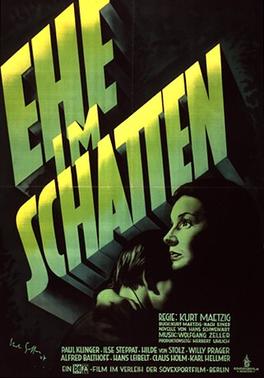
His Trümmerfilm works however are a searing reminder of the horrors of the war. His most powerful film Ehe Im Schatten 1947 takes the terrors of the Holocaust and projects them on to a domestic relationship. In doing this we can see how fascism would affect us in our own lifes, we see our relationships, our families and our proffesions and have to ask what would we do and how would we react in the same situation.
Unfortunately I can recommend this film, however it is difficult to see. It is not available on Amazon or Icestorm I am looking for a copy on line, however when it comes available I will
Maeztig, who as a former socialist resistance fighter, was one of the founders of the East German DEFA film studios. His early films described an anger and desire to prevent any resurrection of fascism in Germany. His obituaries concentrated on his work in the 1950's and 1960's when he directed the lumpy Socialist Realist epics Ernst Thälmann - Führer seiner Klasse and Ernst Thälmann - Sohn seiner Klasse from 1954 and 1955 or his famous banned film Das Kaninchen bin ich 1965.
His Trümmerfilm works however are a searing reminder of the horrors of the war. His most powerful film Ehe Im Schatten 1947 takes the terrors of the Holocaust and projects them on to a domestic relationship. In doing this we can see how fascism would affect us in our own lifes, we see our relationships, our families and our proffesions and have to ask what would we do and how would we react in the same situation.
Unfortunately I can recommend this film, however it is difficult to see. It is not available on Amazon or Icestorm I am looking for a copy on line, however when it comes available I will
Subscribe to:
Posts (Atom)